Quantum spins are just binary numbers
Read a chain of spins as a binary number, and spin operators become simple jumps between integers: the idea behind our Dirac representation.
Dieser Artikel ist auf Englisch verfügbar.
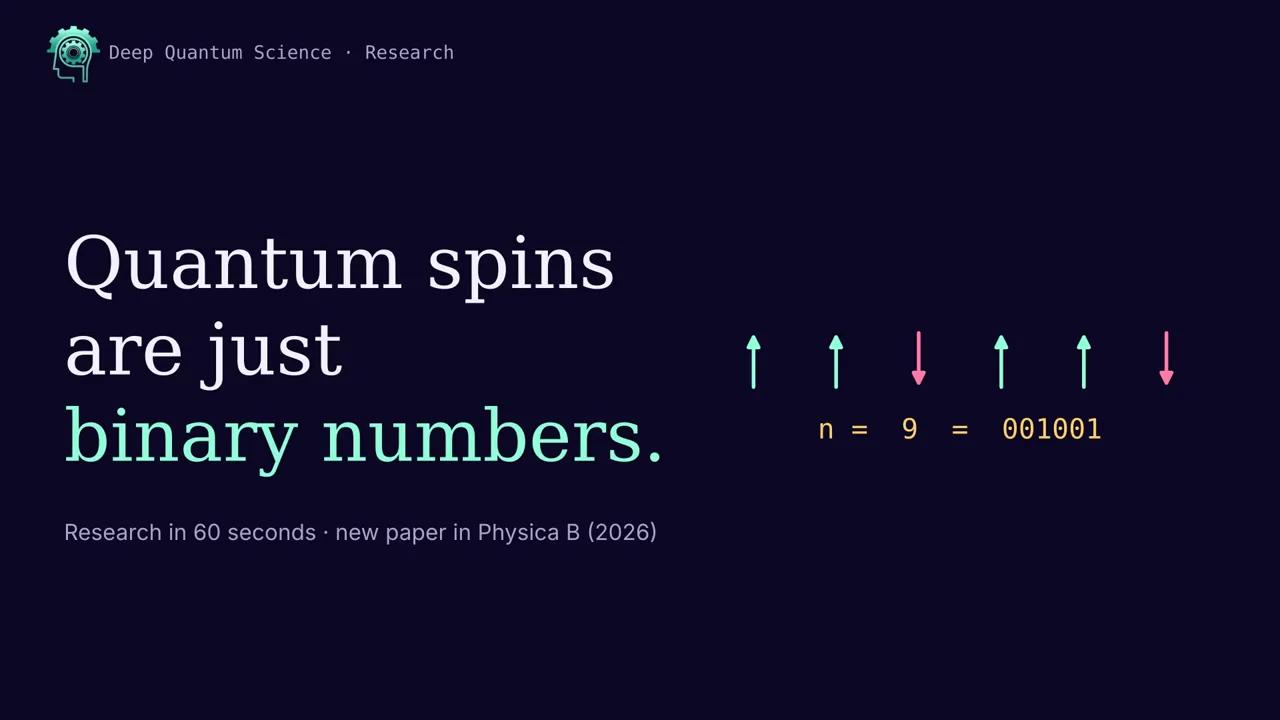
Spin systems are everywhere in physics: magnets, qubits, cold atoms in optical lattices. Their standard description uses tensor products of small matrices, one per site. That is exact, but it quickly becomes hard to read and to compute with. In our paper in Physica B we start from a much simpler picture.
Spins are bits
Write spin up as 0 and spin down as 1. A row of K spins is then a string of K bits, and therefore an ordinary integer n between 0 and 2K−1. For three spins, ↑↓↑ is 010, which is the number 2.
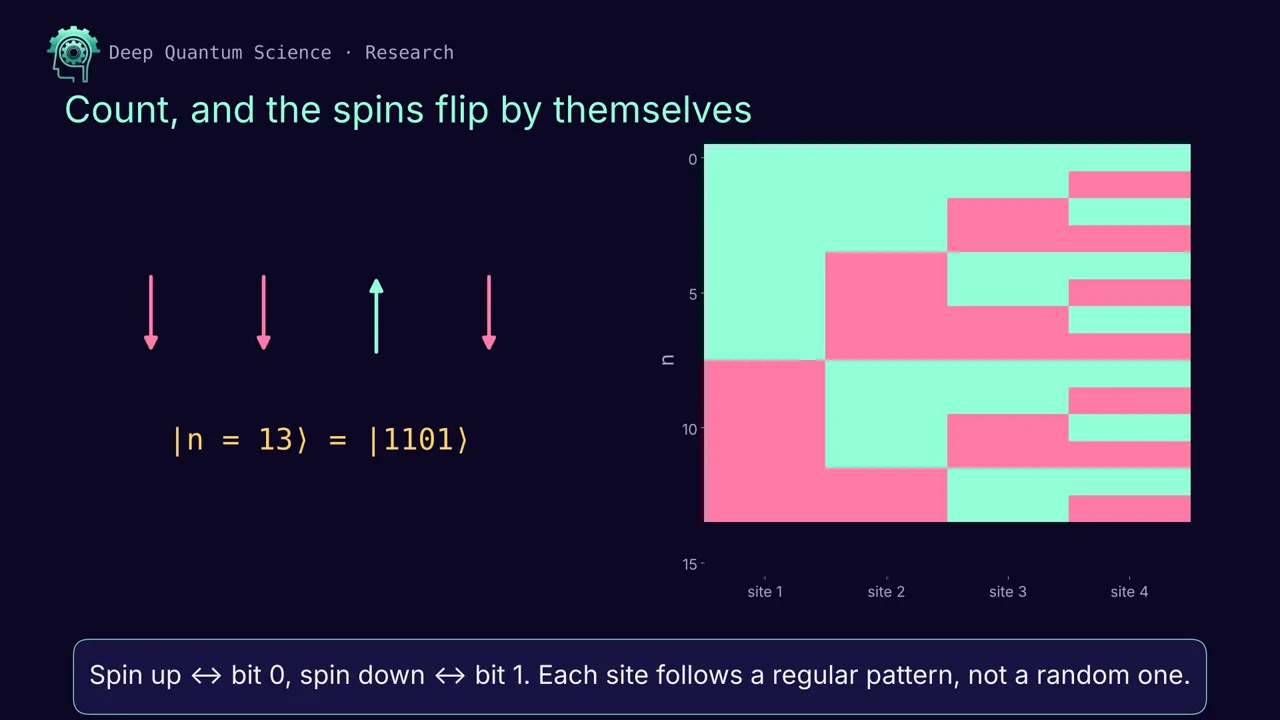
If you count from 0 upwards, each site flips with a perfectly regular rhythm: the last site every step, the one before every two steps, and so on. Site j has a weight qj = 2K−j.
Flipping a spin is a jump
Turning spin j from up to down adds qj to the number. So the lowering operator is nothing but a jump on the number line:
The coefficient sn(j) is a gatekeeper: it equals 1 when spin j is up in configuration n and 0 otherwise, so a spin that is already down cannot be lowered further. The z component is diagonal: it simply reads a digit of n.
The key result of the paper is that these digits have a closed formula made of unit-step functions, so one never needs to convert n to binary by hand:
Why this is useful
- No Jordan–Wigner strings. Operators on different sites commute and stay local.
- Any dimension, any lattice. Geometry only enters through which pairs of sites interact.
- Exact algebra. [S+, S−] = 2Sz holds exactly. We checked numerically that the operators coincide with the usual tensor products.
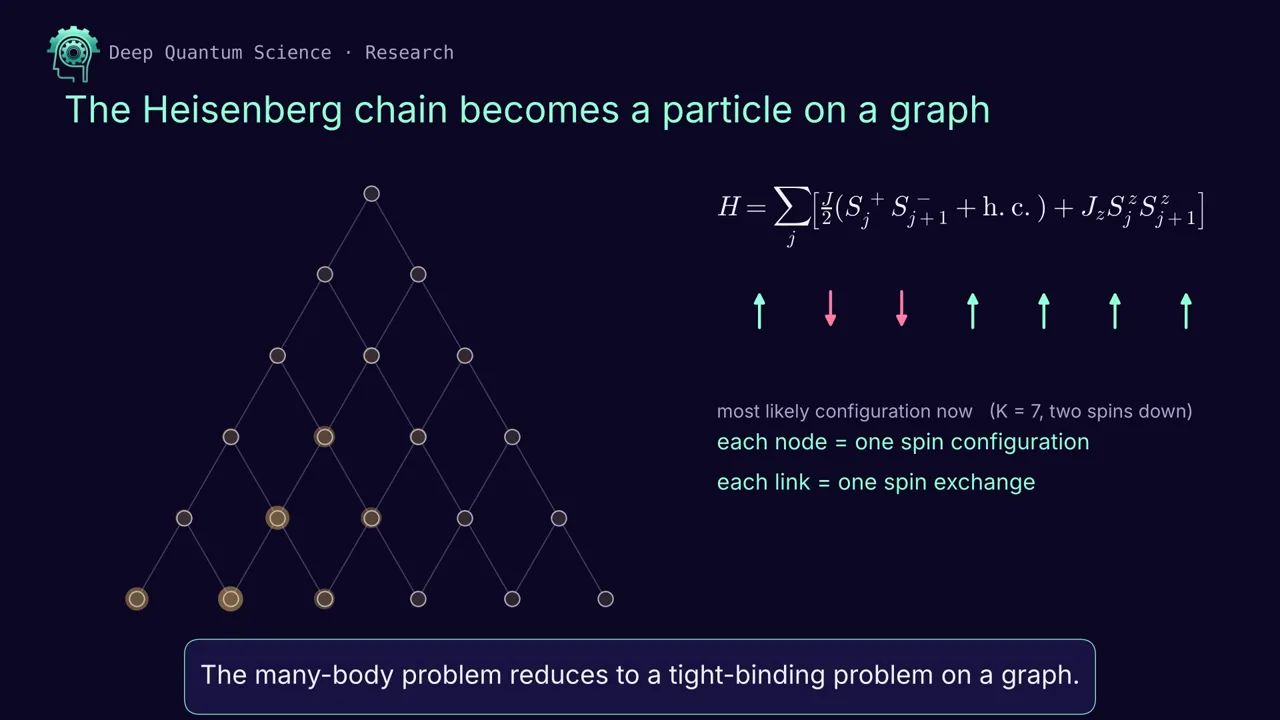
- Spin chains become hopping problems. The Heisenberg (XXZ) chain turns into a single particle hopping on a graph of configurations.
The paper also treats spin-1, where each site carries three states instead of two. The same ideas power the next two articles on perturbation theory.