Perturbation theory explained like you’re 10
Tiny magnets on a bumpy road: how physicists estimate energies when the exact problem is too hard, step by step and with real numbers.
Dieser Artikel ist auf Englisch verfügbar.
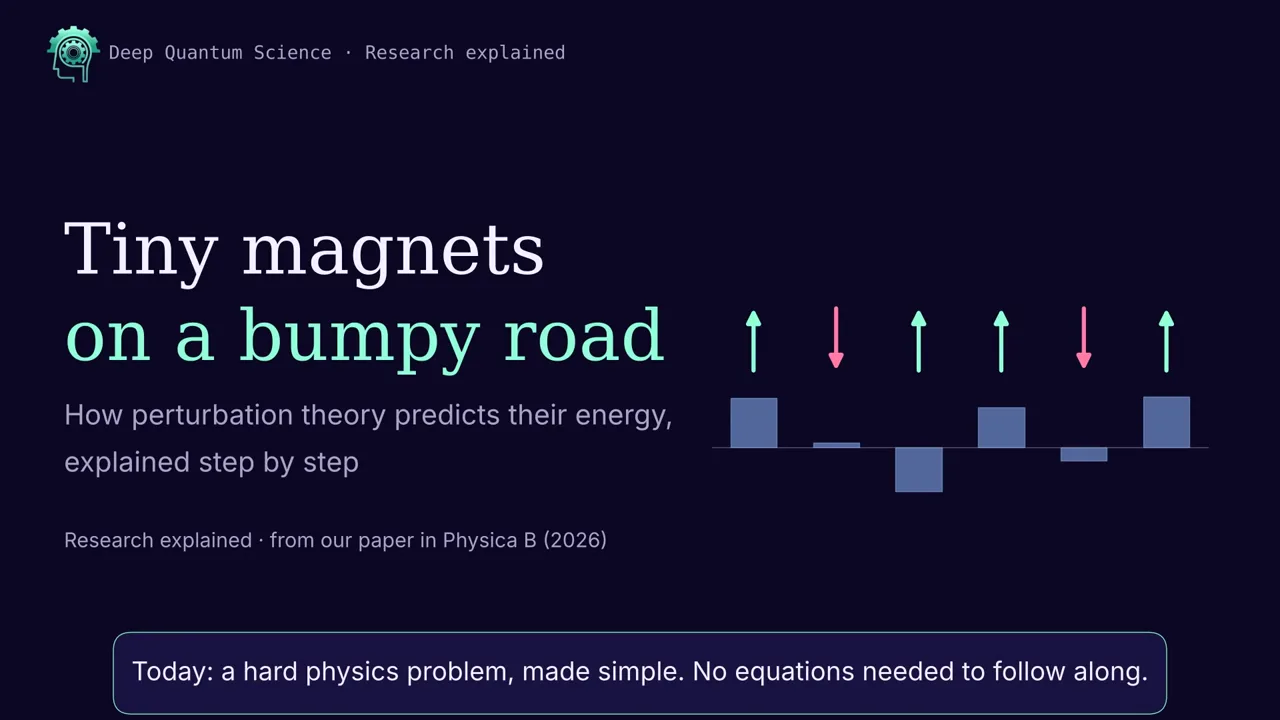
Most quantum problems cannot be solved exactly. Perturbation theory is the art of starting from an easy problem and adding small corrections, one at a time. Here is the idea, using the disordered spin chain from our paper.
The easy world: nobody moves
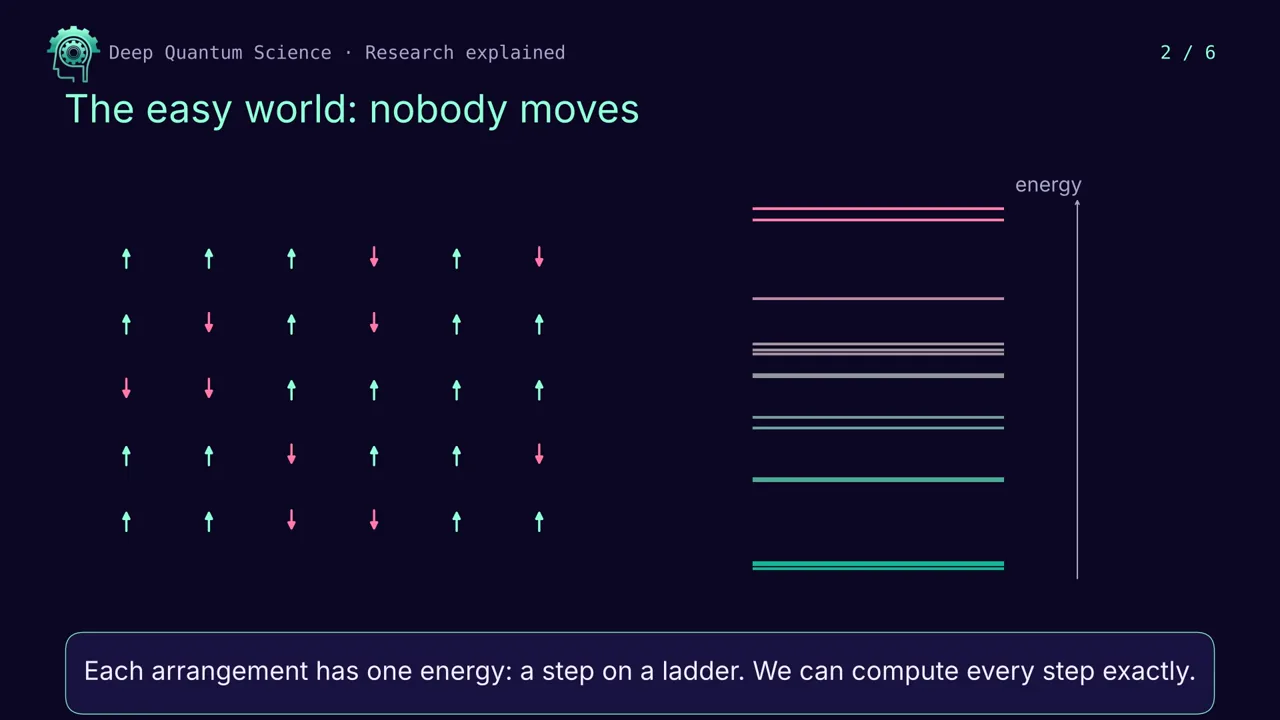
Take a row of six tiny magnets, each sitting on a random magnetic field (a "bump" in the road), with neighbours that feel each other. If the magnets cannot swap places, every arrangement has one fixed energy: a step on a ladder. With two magnets pointing down there are 15 arrangements, and we can compute every step exactly.
Small hops
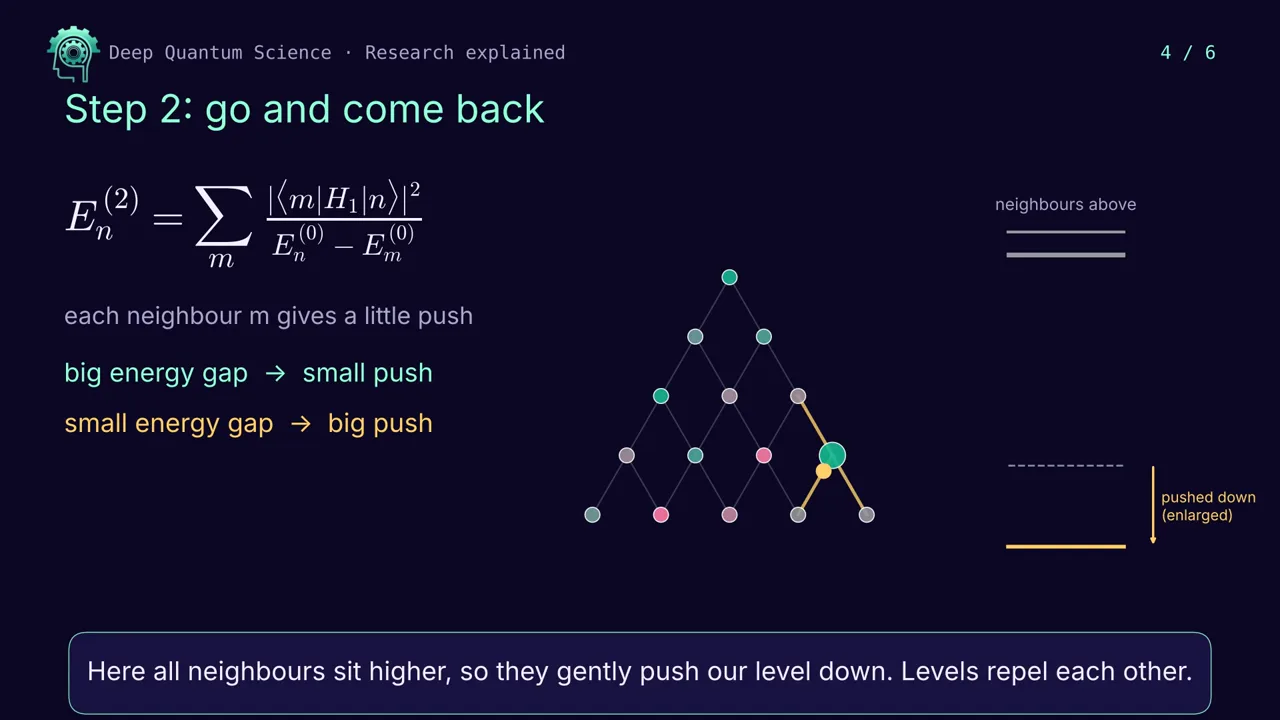
Now neighbouring up and down magnets may swap, with a small strength J. Draw each arrangement as a dot and each possible swap as a link: from any dot you can only hop to a few neighbouring dots. Because J is small, the system mostly stays home and only peeks next door.
The recipe
- Step 0 is the height of your own ladder step.
- Step 1 is zero. After a single hop you are somewhere else, and only trips that come back home change the energy.
- Step 2: go and come back. Each neighbour m gives a push |Vnm|² / (En − Em). Far-away energies barely matter; close energies matter a lot. Levels repel each other.
A chessboard trick
Colour the arrangements like a chessboard. Every hop changes the colour (the graph is bipartite), so after an odd number of hops you can never be home. Steps 1 and 3 vanish exactly, and two simple terms already give the energy with an error of order J4.
Does it work?
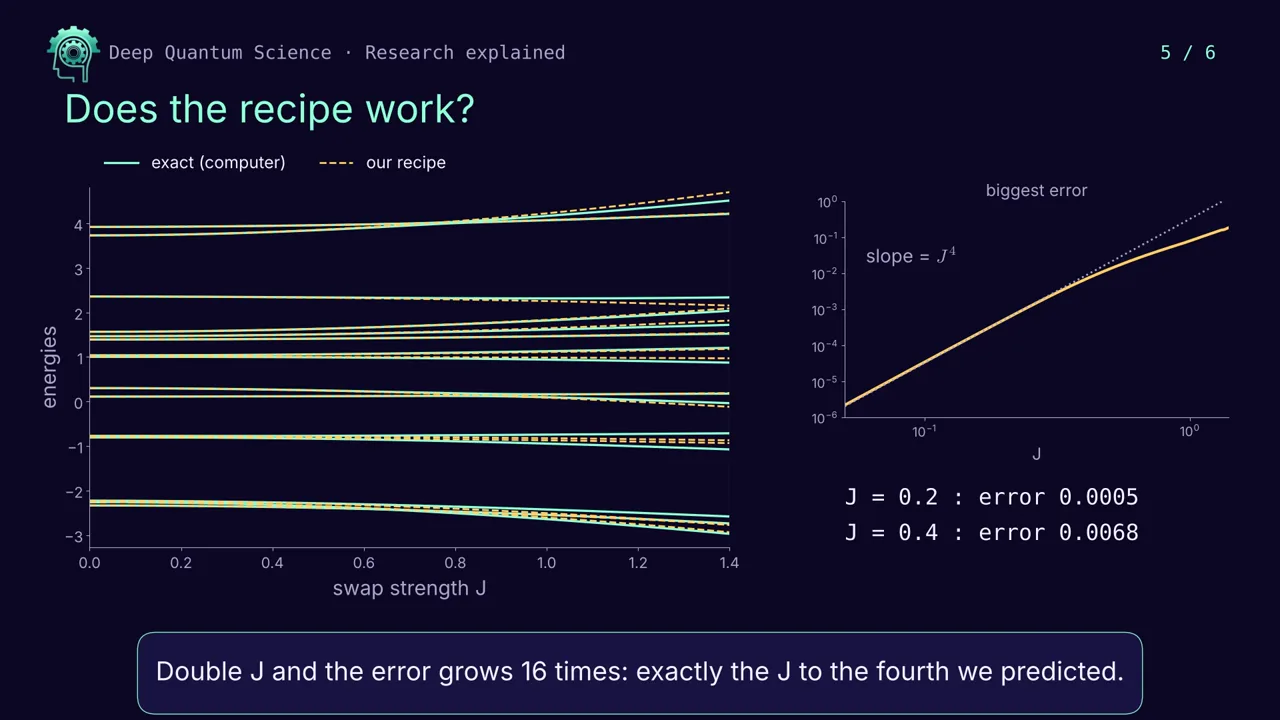
We compared the two-term recipe with exact diagonalisation. The largest error over all 15 levels is 0.0005 at J = 0.2 and 0.0068 at J = 0.4: doubling J multiplies the error by about 16, exactly the J4 we predicted. For large J the recipe breaks down, as expected for a small-J theory.