Can a quantum system remember its past? Many-body localisation
Most systems forget where they started. With strong disorder, interacting quantum spins can refuse to. Three fingerprints, computed exactly.
Dieser Artikel ist auf Englisch verfügbar.
Drop ink in water and wait: it spreads everywhere, and soon you cannot tell where the drop was. Physicists call this thermalisation, and almost every system does it. Many-body localisation (MBL) is a striking exception: with enough disorder, a system of interacting quantum particles can keep a memory of its initial state.
The memory experiment
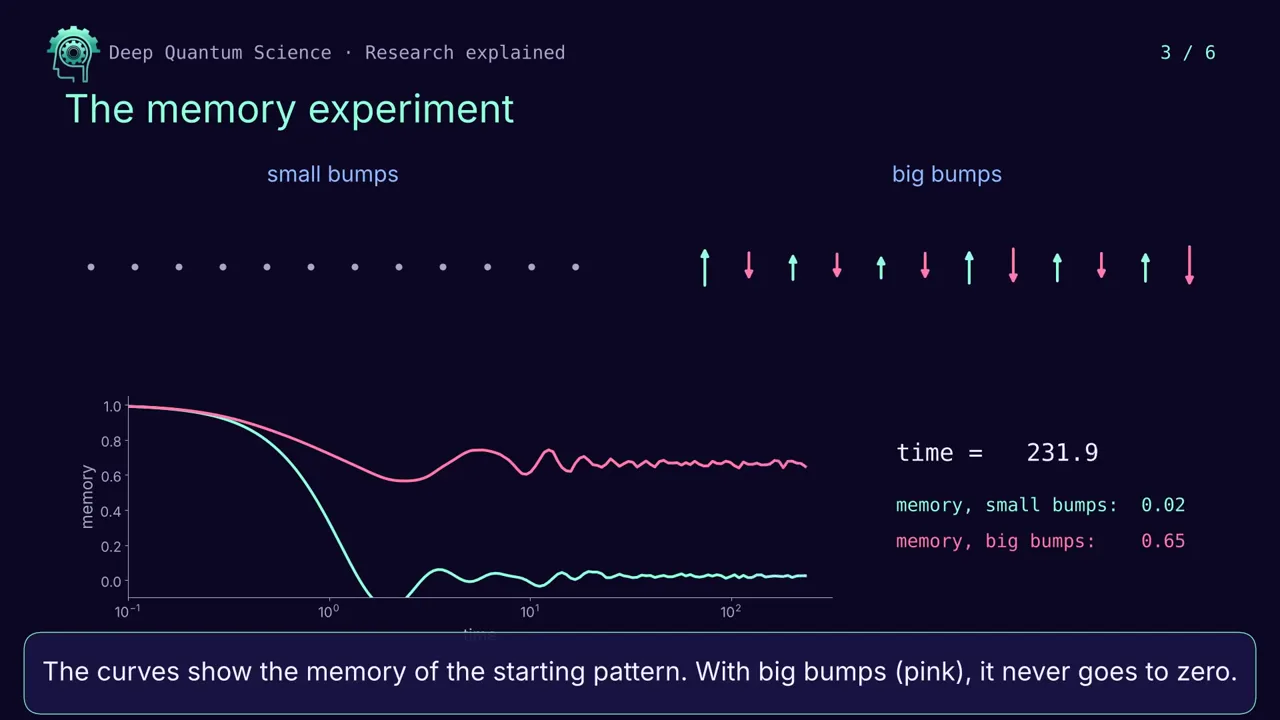
We take a chain of 12 spins with neighbour interactions and a random magnetic field of strength up to W on each site, start from the pattern up, down, up, down, and let it evolve. All results below come from exact diagonalisation, averaged over 40 disorder realisations.
Why it gets stuck
Follow a single flipped spin. With small bumps it spreads like a wave; with big bumps it stays near its starting point. In the perturbative picture of our paper, the hopping strength between two configurations is inversely proportional to the difference of their local fields: with large random fields, almost every hop is a step too high.
Three fingerprints
- Concentrated eigenstates. The inverse participation ratio IPR = Σm |⟨m|ψ⟩|4 measures how concentrated a state is. It grows steadily with W.
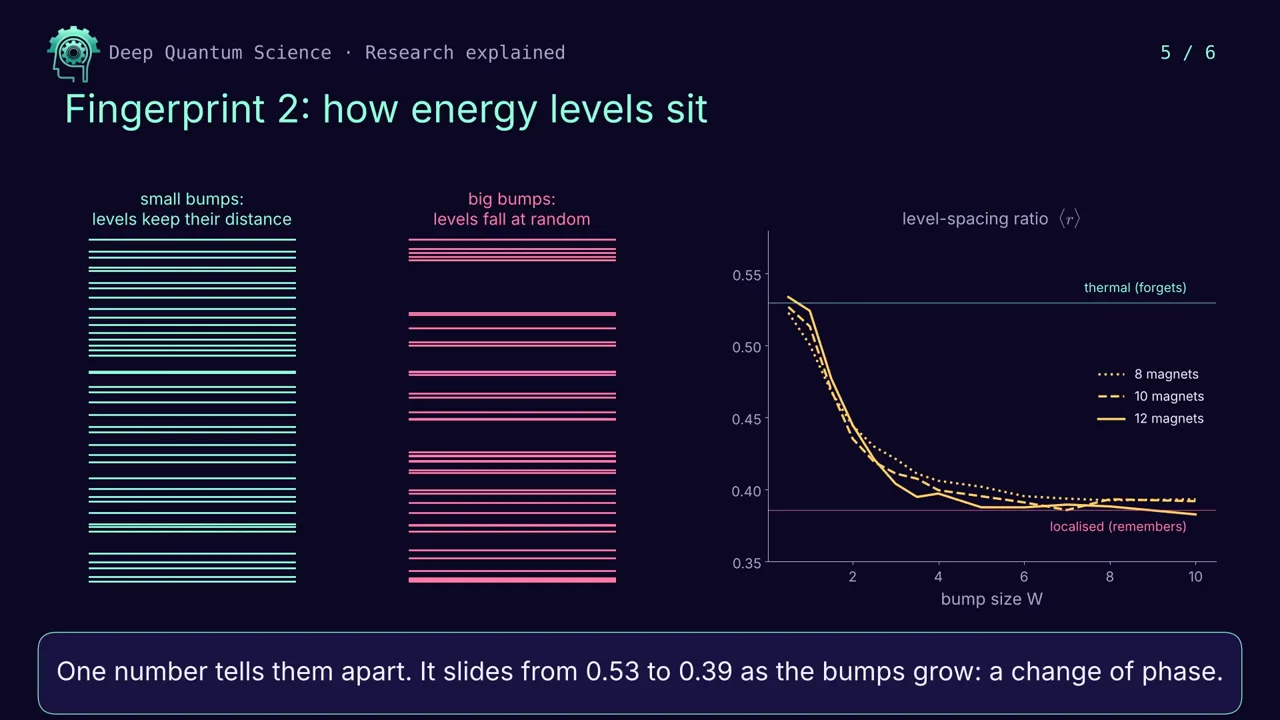
- Random energy levels. In the thermal phase levels repel each other; in the localised phase they fall at random. The mean level-spacing ratio ⟨r⟩ slides from about 0.53 (Wigner–Dyson) to about 0.39 (Poisson) as W grows.
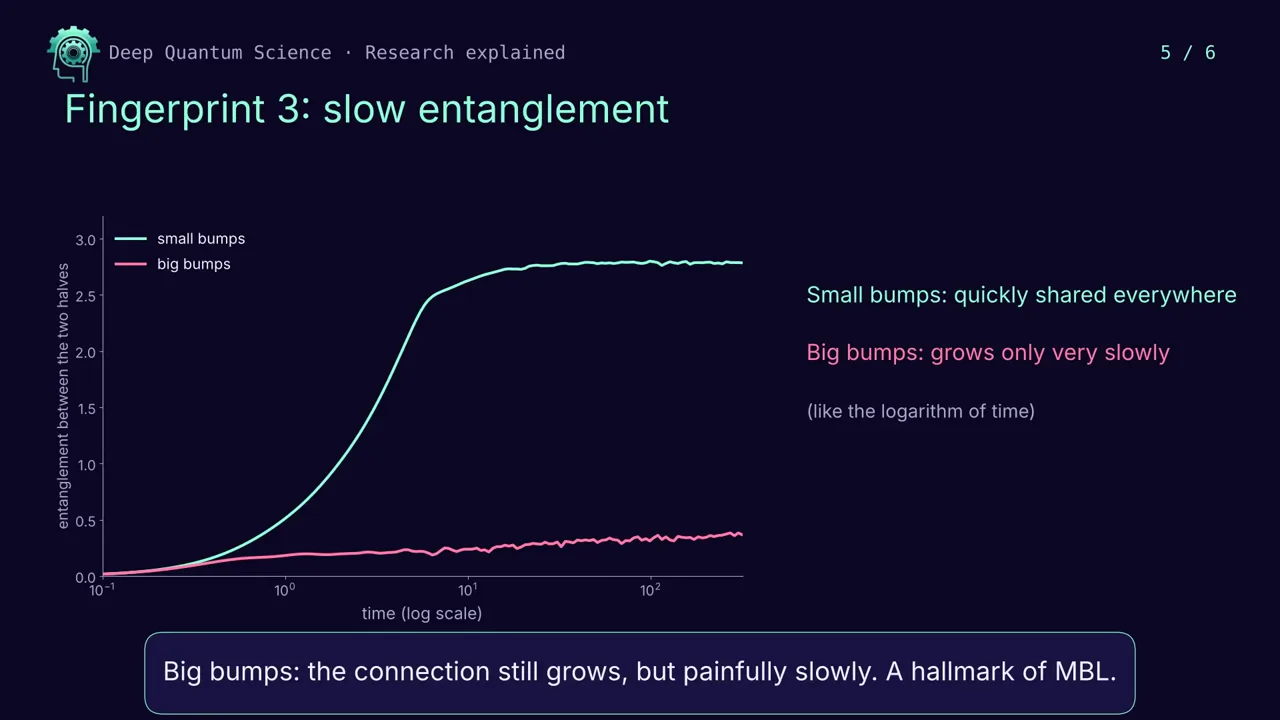
- Slow entanglement. Entanglement between the two halves of the chain saturates quickly for weak disorder, but grows only very slowly, roughly like the logarithm of time, for strong disorder.
Why it matters
An MBL system never heats up and never forgets, which makes it interesting for protecting quantum information and a test bed for quantum simulators with cold atoms and qubits. It is also still an open question: whether MBL survives in very large systems is actively debated, and small chains like ours shift the apparent transition point. Our Dirac representation turns these chains into hopping problems on a graph, a useful new angle on the puzzle.