The Haldane chain: a gap that should not be there
Integer spins keep an energy gap, hide a perfect up–down order and carry half spins at their ends. We compute it all exactly with our base-3 representation.
Dieser Artikel ist auf Englisch verfügbar.
In the previous article we wrote spin-1 operators as jumps between integers written in base 3. Here we put this representation to work on one of the most famous problems of quantum magnetism: the spin-1 Heisenberg chain, better known as the Haldane chain. Every number below comes from our own exact calculations.
A chain of spin-1 magnets
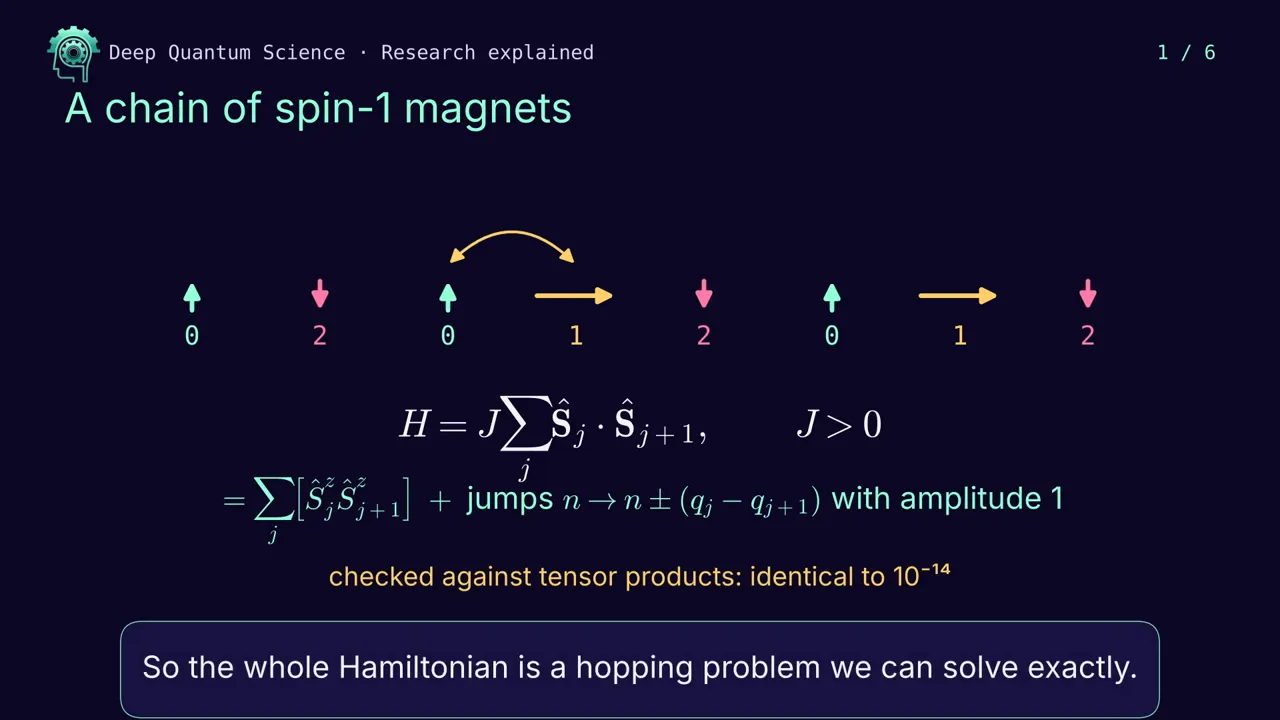
Line up spin-1 magnets whose neighbours prefer to point in opposite directions. This is the Heisenberg antiferromagnet:
In the base-3 representation, the SzSz part is diagonal: it just reads the digits of each configuration n. The exchange part moves one unit of spin between neighbours, which is a jump n → n ± (qj − qj+1) with amplitude exactly 1 whenever the gatekeepers allow it. The chain becomes a hopping problem on the integers. We checked that the resulting Hamiltonian has exactly the same eigenvalues as the usual tensor-product construction (largest difference 10−14).
Haldane's conjecture
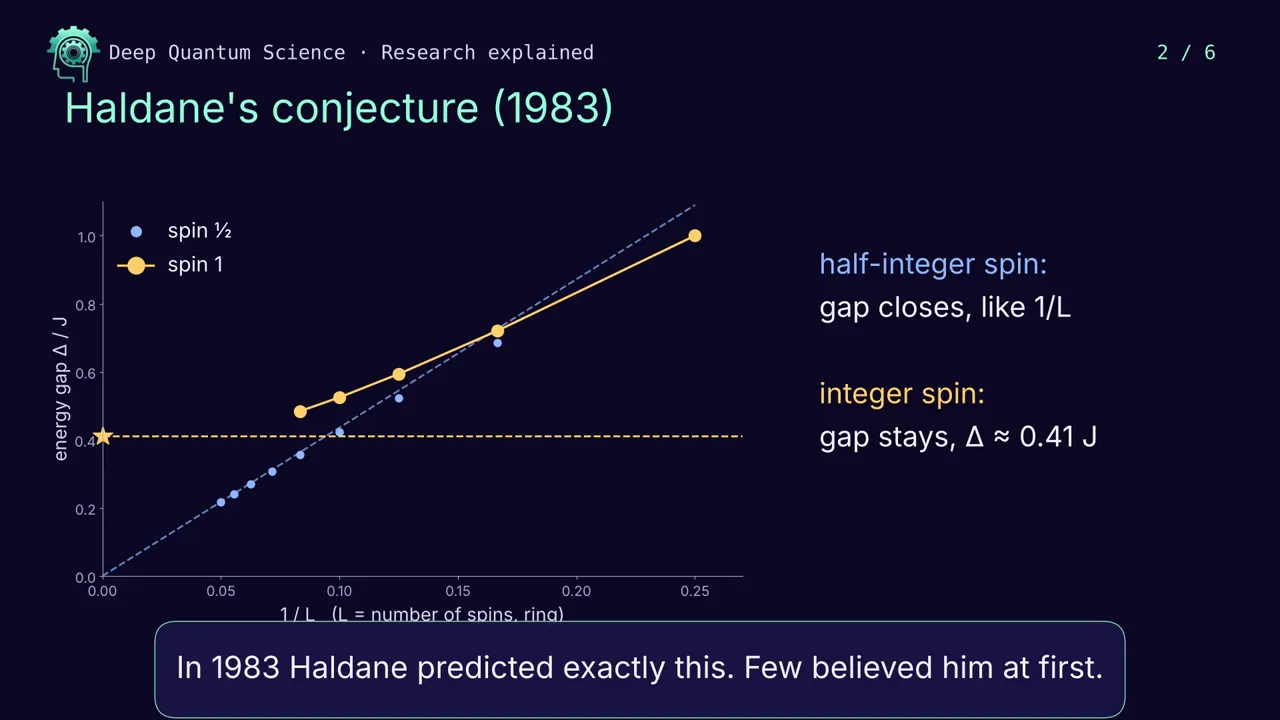
The energy gap is the energy needed to create the smallest excitation. For spin ½, our exact gap on rings of up to 20 spins shrinks like 1/L: a long chain has no gap. For spin 1, on rings of up to 12 spins, the gap decreases much more slowly (0.48 J at L = 12) and approaches the value Δ ≈ 0.41 J obtained by large-scale numerical studies.
In 1983 Duncan Haldane predicted exactly this difference: chains of half-integer spins are gapless, chains of integer spins are gapped. The prediction was surprising at the time; it is now firmly established, and it was part of the work recognised by the 2016 Nobel Prize in Physics.
A hidden order
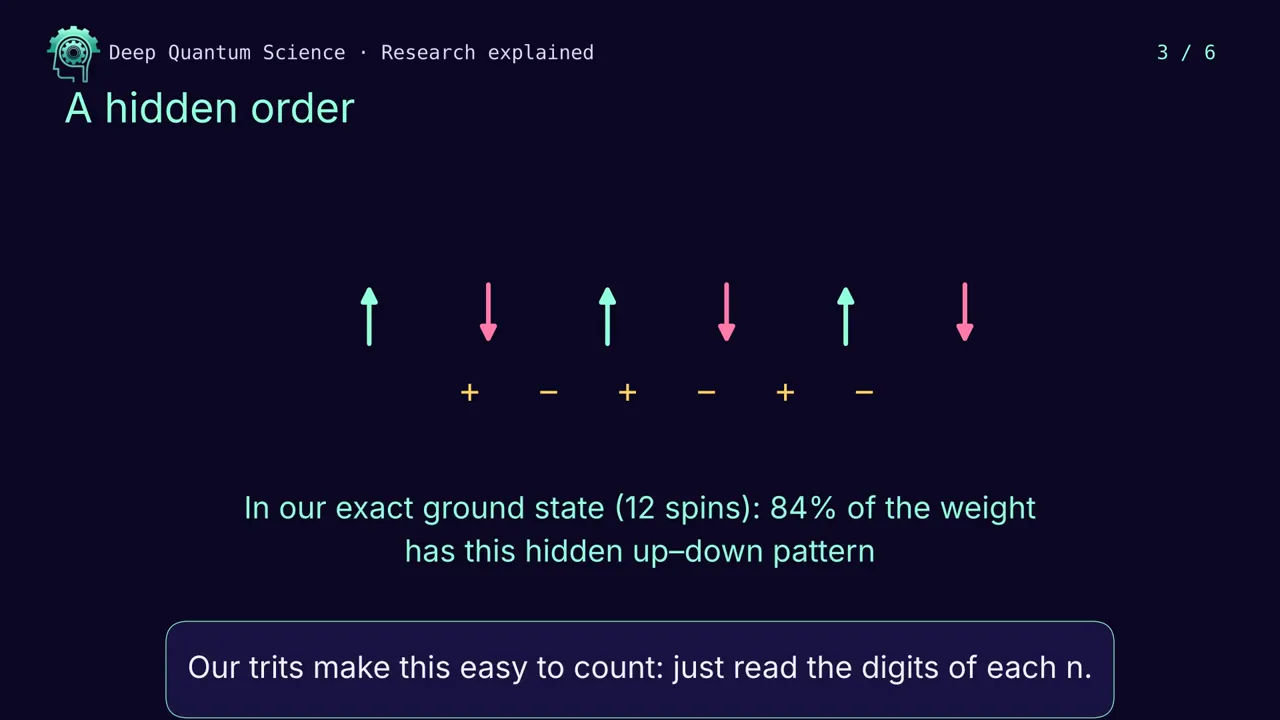
A typical configuration of the ground state looks disordered: up, flat and down spins mixed together. But delete every flat spin, and what remains alternates perfectly: up, down, up, down. In base 3 this is easy to test, because we only need to read the digits of each n. In our exact ground state of 12 spins, 84% of the weight has this hidden pattern.
String order
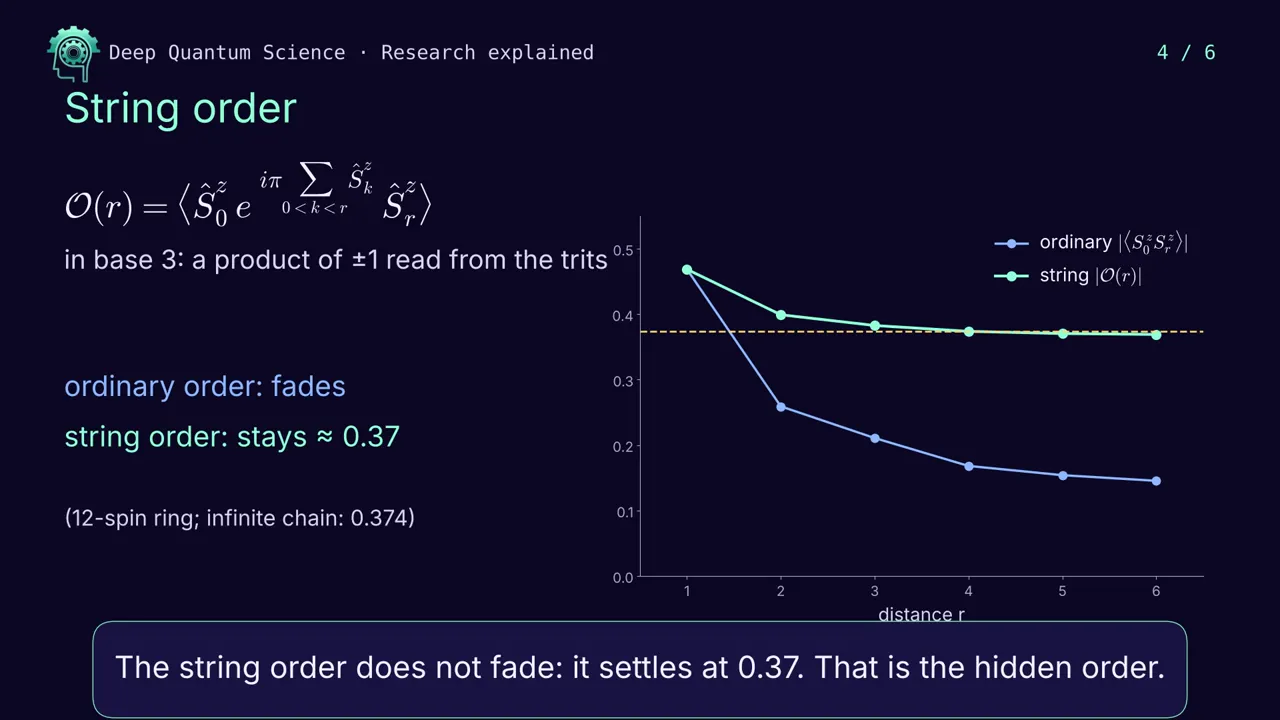
Physicists measure this hidden order with the string correlator of den Nijs and Rommelse:
Each flat spin in between contributes +1, each up or down spin −1, so in base 3 the string is just a product of ±1 read from the trits. The ordinary spin correlation fades with distance (on a long chain it dies out after about six sites), while the string order settles near 0.37 on our 12-spin ring, close to the infinite-chain value 0.374.
The AKLT picture
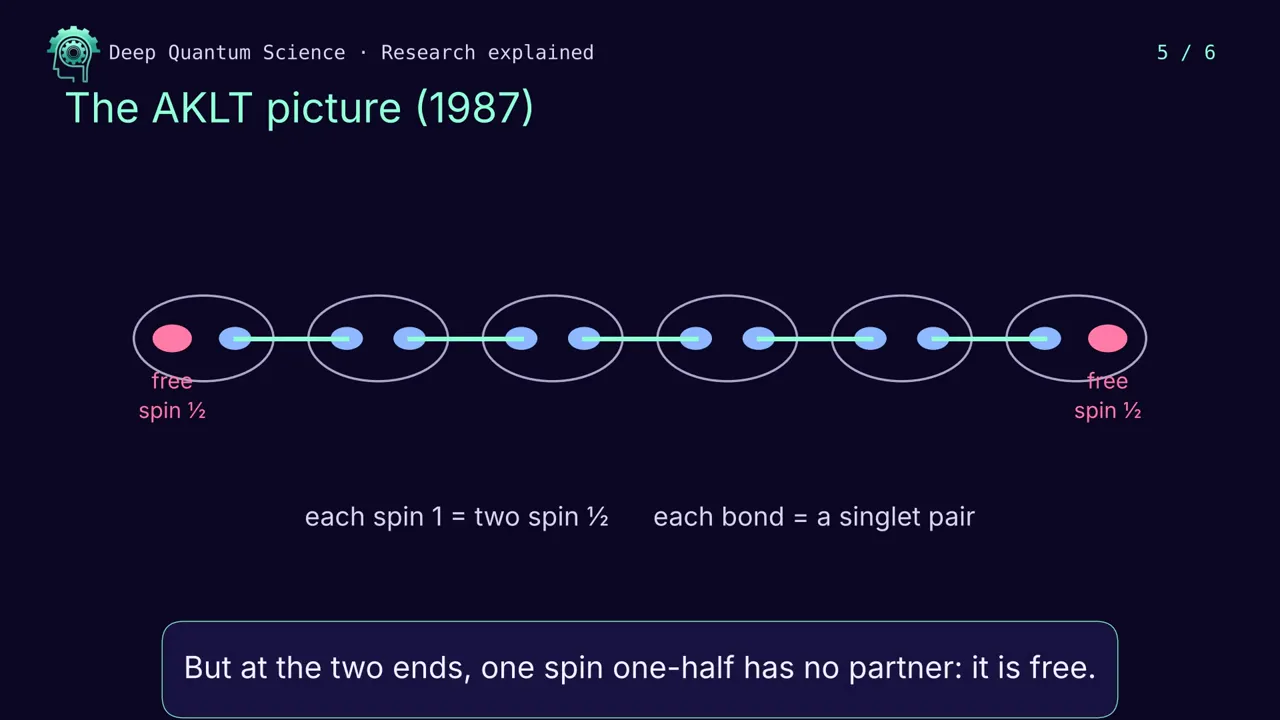
In 1987 Affleck, Kennedy, Lieb and Tasaki found an exactly solvable model in the same phase, with a simple picture. Split each spin 1 into two spin ½. Pair every half with a half on the neighbouring site into a singlet bond. The bulk is locked, which explains the gap and the hidden order. At the two ends of an open chain, however, one spin ½ has no partner: it is free.
Edge states, computed exactly
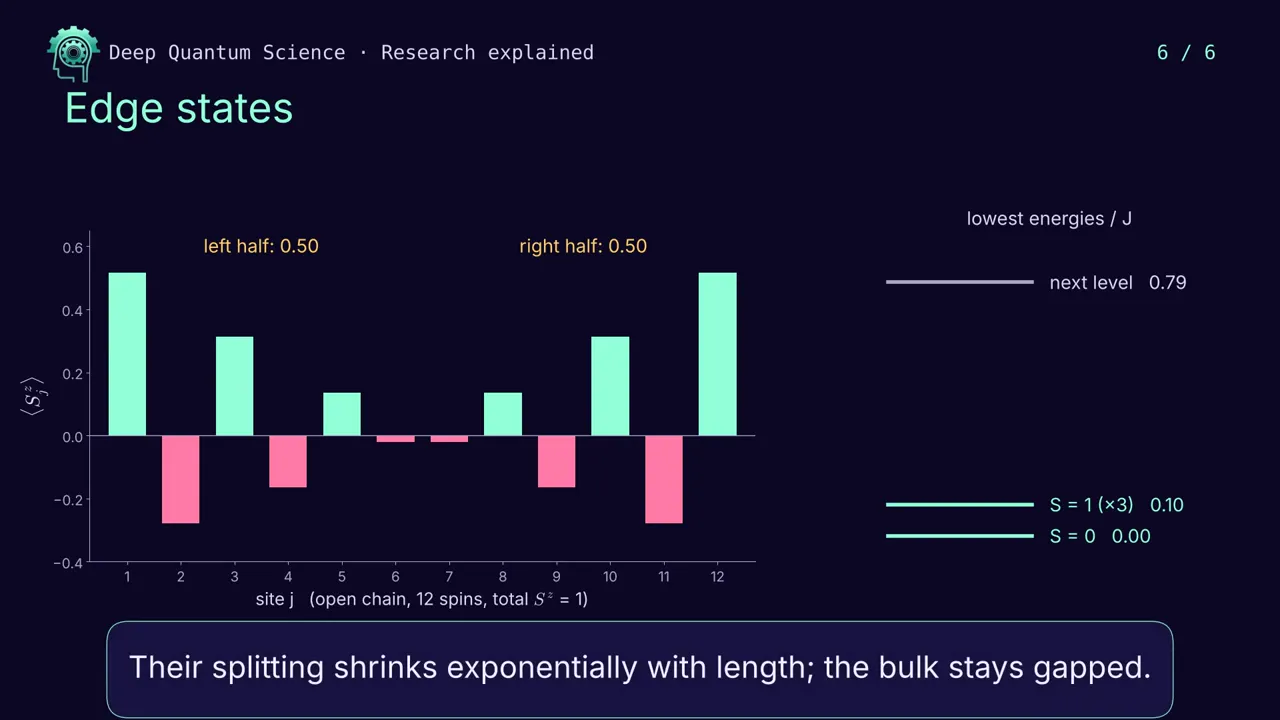
We tested this on an open chain of 12 spins with one unit of total magnetisation. The magnetisation sits at the two ends, and each half of the chain carries exactly 0.50: half a spin per edge. The two free halves also show up in the spectrum: the four lowest states, a singlet and a triplet, lie within 0.10 J of each other. This splitting shrinks exponentially with the length of the chain, while the next level lies 0.79 J higher.
Why it matters
- The Haldane gap was measured in nickel-based chain compounds such as NENP by neutron scattering in 1987.
- The Haldane phase is the first example of a symmetry-protected topological phase, a concept now central in condensed-matter physics.
- AKLT-type states are resources for measurement-based quantum computing.
For us, the Haldane chain is a demanding test of the base-3 Dirac representation: the gap, the hidden order and the edge states all follow from simple jumps between integers.