From bits to trits: spin-1 operators as base-3 numbers
A spin 1 has three positions. Read them as the digits 0, 1, 2, and spin-1 operators become jumps between integers written in base 3.
Dieser Artikel ist auf Englisch verfügbar.
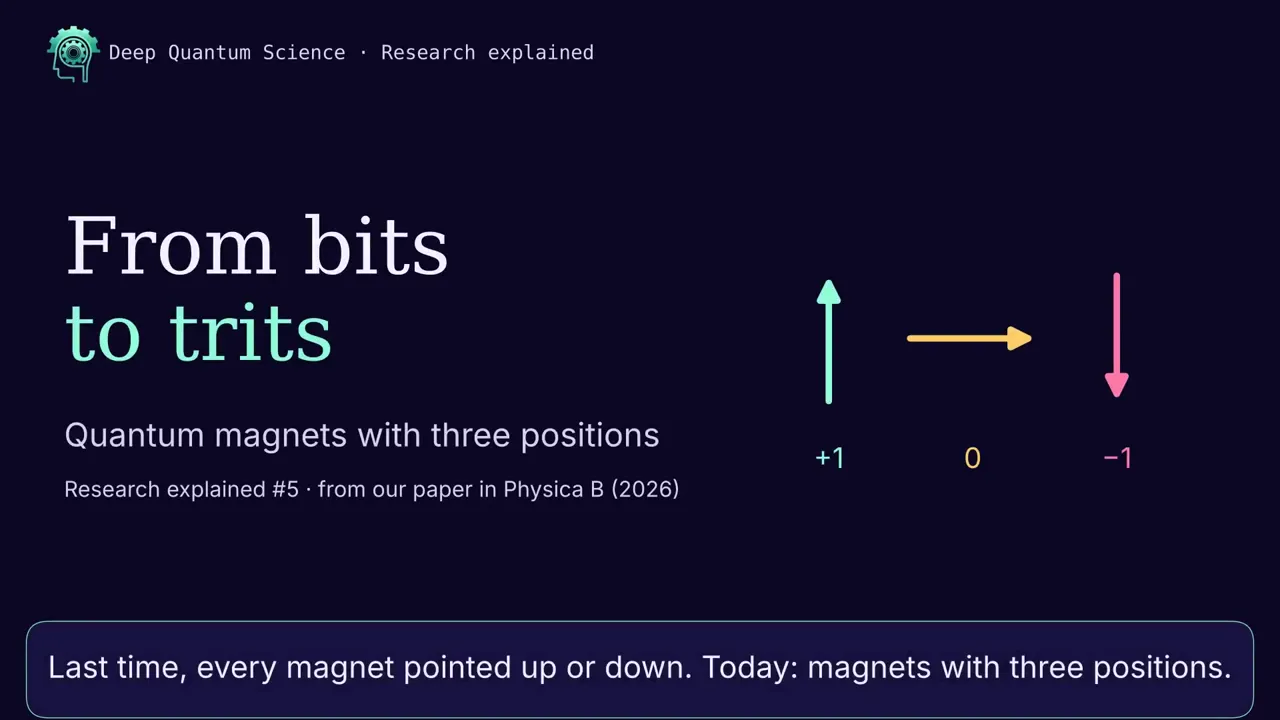
In the first article of this series, a chain of spin-½ particles became a binary number, and spin operators became jumps between integers. Section V of our paper in Physica B asks the natural next question: what happens when each magnet has three positions instead of two?
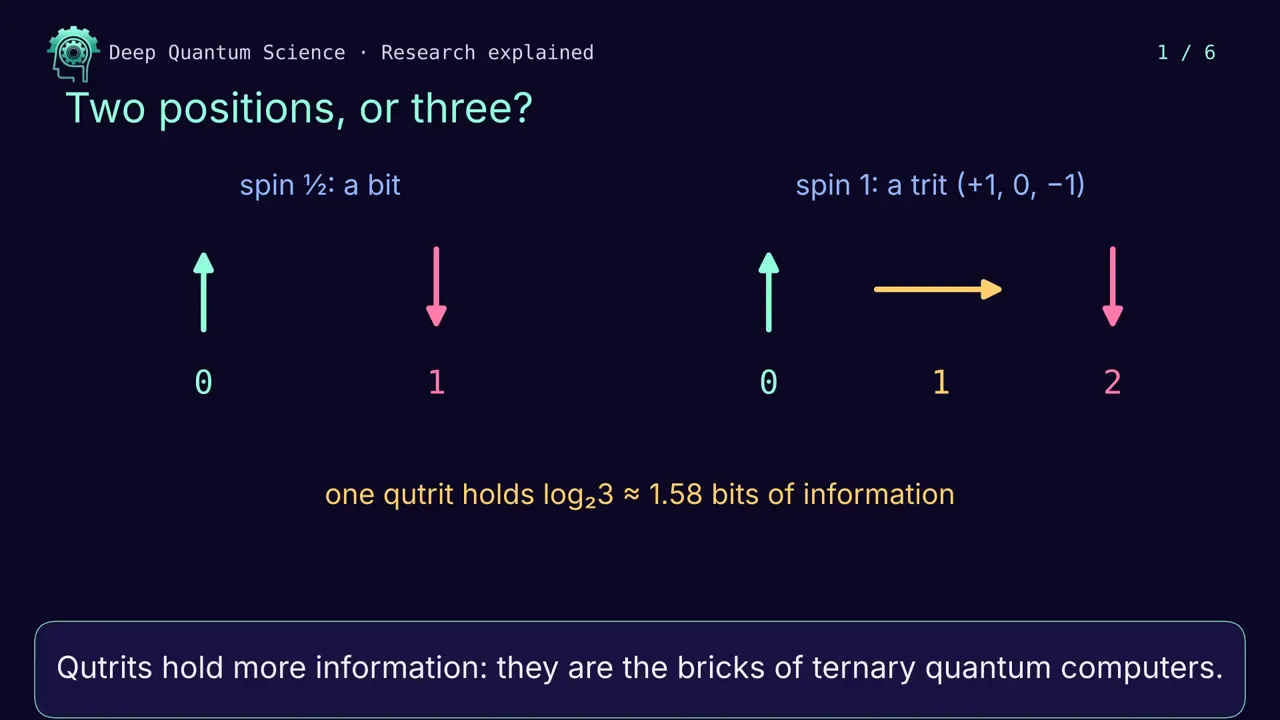
Two positions, or three?
A spin 1 can point up (m = +1), lie flat (m = 0) or point down (m = −1). We write these as the digits 0, 1 and 2. One such three-level system is a qutrit, and it carries log23 ≈ 1.58 bits of information. Qutrits are the building blocks of ternary quantum processors, which several experimental groups are now developing.
Counting in base 3
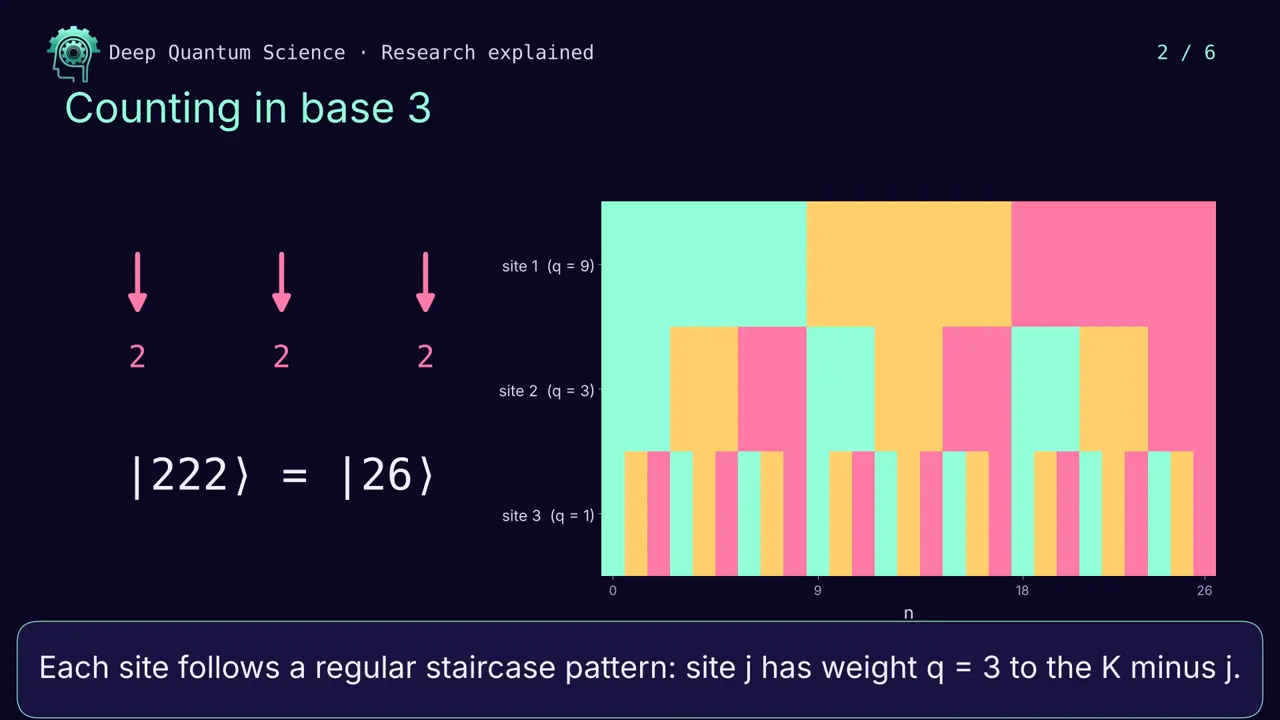
A row of K spin-1 sites is now a string of K trits, so every configuration is an integer n between 0 and 3K−1. For three sites, all spins down is |222⟩ = |26⟩. Counting upwards, each site again follows a regular staircase, and site j carries the weight
Turning a spin is a jump
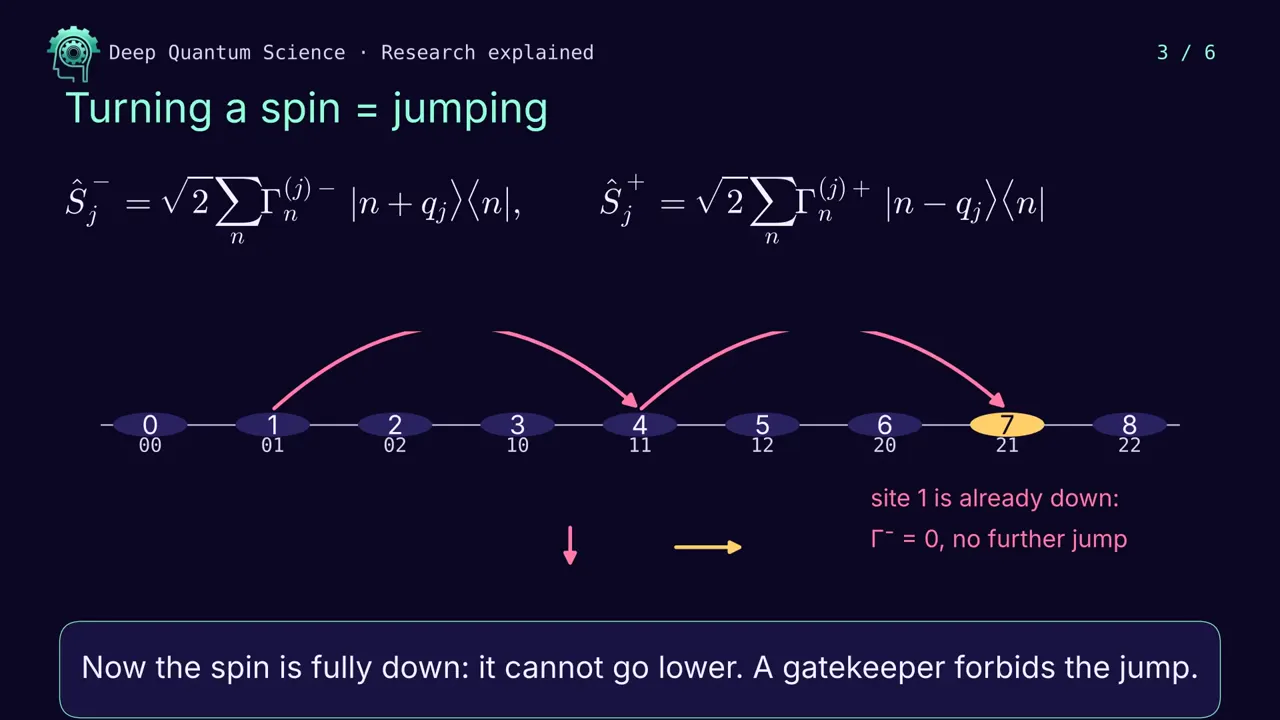
Lowering spin j by one unit (from up to flat, or from flat to down) increases its digit by one, so n increases by qj. Raising it does the opposite. The spin-1 ladder operators are therefore jumps on the number line, with the usual factor √2:
On two sites, lowering the first spin takes 1 (digits 01) to 4 (digits 11), then to 7 (digits 21). From there the first spin is fully down and no further jump is allowed.
The gatekeepers Γ
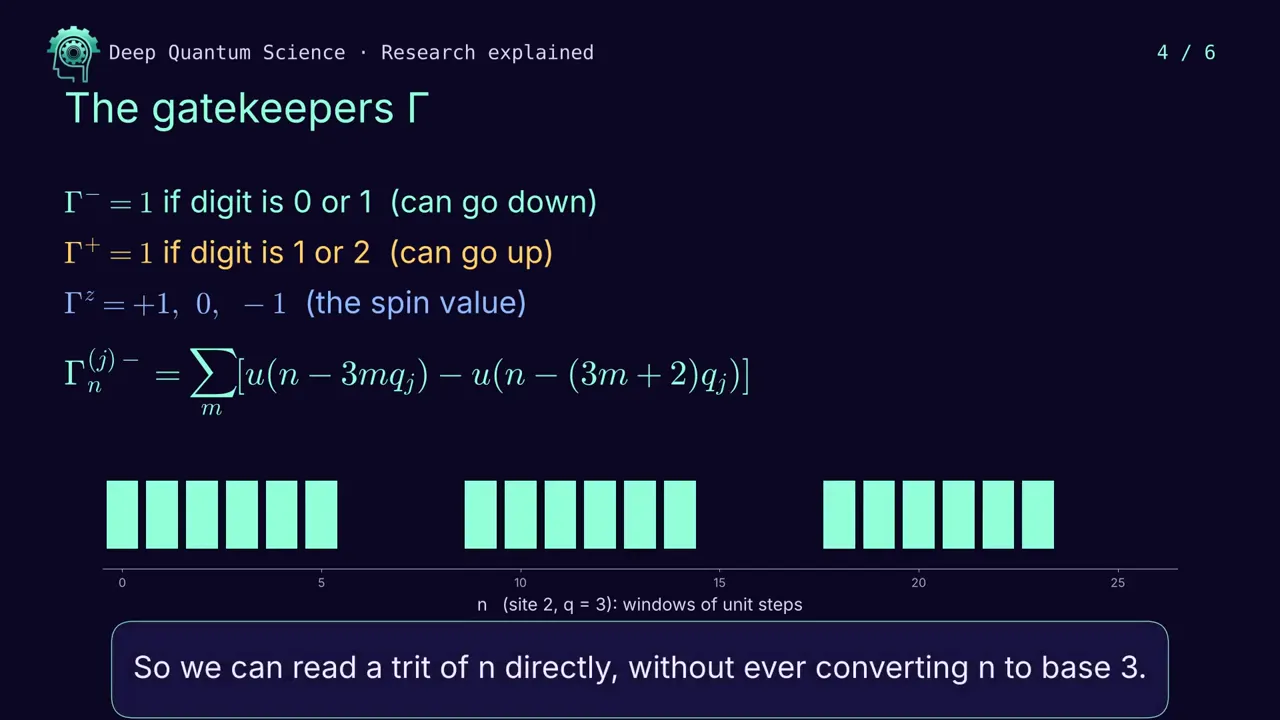
The coefficients Γ decide whether a jump is allowed. Γ− equals 1 when the digit of site j is 0 or 1 (the spin can still go down), Γ+ equals 1 when it is 1 or 2 (it can still go up), and the diagonal operator Sz uses Γz = +1, 0, −1, which is simply Γ− − Γ+.
As for spin ½, these digits have closed formulas built only from unit-step functions u, so one never needs to convert n to base 3:
Each term is a window of width 2qj that repeats with period 3qj: exactly the values of n whose j-th trit is 0 or 1.
Does it work?
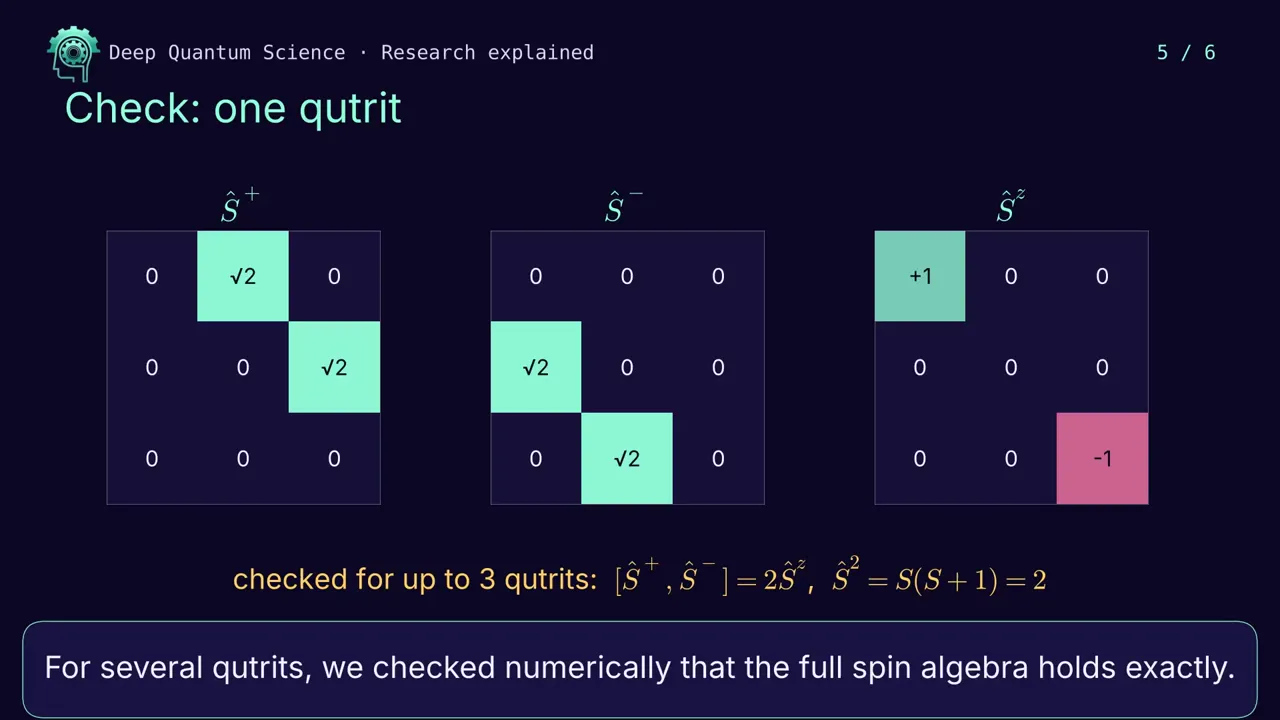
For one qutrit the construction gives the familiar 3×3 spin-1 matrices. For chains of up to three qutrits we checked numerically that the operators coincide with the usual tensor products and that the full algebra holds exactly: [S+, S−] = 2Sz, [Sz, S±] = ±S± and S2 = S(S+1) = 2 on every site.
Any spin: change the base
| Spin | Base | Digits | Weight of site j |
|---|---|---|---|
| ½ | 2 | bits | 2K−j |
| 1 | 3 | trits | 3K−j |
| 3/2 | 4 | quarts | 4K−j |
| S | 2S+1 | qudits | (2S+1)K−j |
The pattern is the same for every spin: count in base 2S+1, and spin operators become gated jumps on the integers. Spin-1 chains, such as the Haldane chain, and qutrit quantum processors are natural playgrounds for this tool.